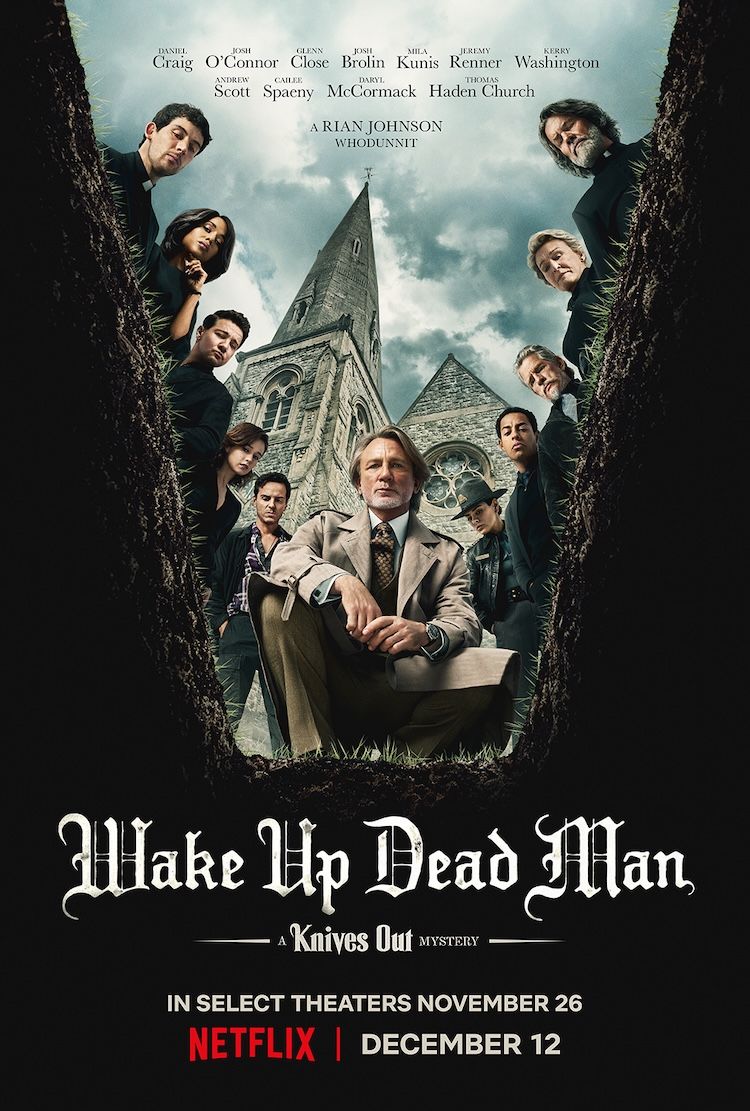
Wake Up Dead Man

There are three ways to evaluate Wake Up Dead Man: as a
- film;
- whodunit;
- entry in the Knives Out canon.
As a film
This was a very, very entertaining two and a half hours. I did not care for glass-onion, its predecessor, and I think this recovers from all of its missteps: the humor and plot are a little tighter, the script is a little less indicative of Rian Johnson spending too much time on Twitter, and the setting, production value, and aesthetic are all immaculate.
But, moreover: Josh O'Connor's performance is not just good relative to this extremely accomplished bench of players in the background (Glenn Close! Andrew Scott!), but ascendant in its own right. Father Jud is probably the most interesting character in this entire series outside of Blanc himself, and O'Connor brings him to light with a nuance and warmth missing from even the sympathetic characters in this series. Between this and Challengers last week, I suddenly have a deep and great appreciation for this burgeoning young actor. Not exactly a hot take, I'm aware.
I think this movie's first goal is to entertain and delight, and its second goal is to seriously engage with its motifs on faith and doubt: where it succeeds in the second, it is on the back of Father Jud. (And in particular, the construction worker scene — you know the one — is Johnson at his finest, zagging from comedy to pathos and avoiding whiplash.)
As a whodunit
The contract between reader and writer of a whodunit is important. The joy in this medium, especially when executed well, is a real sense that you, as the reader or viewer, could have put the pieces together yourself — the joy in consumption is active because while you're enjoying the text of the work, you also get to try and be one or two steps ahead or behind the creator.
This sounds obvious, but one of the reasons why Agatha Christie is, well, Agatha Christie, is that she knew how to balance this perfectly. The average Poirot mystery had you entering the final act with a handful of suspects who you all had reasons to believe were guilty, and were rich enough in their character that it wouldn't be completely out of left field if they ended up being the culprit. The best parlor scenes, accordingly, were less about filling in the gaps and more about drawing a through line between disparate clues that you had already picked up but had not connected.
And here even more so than the previous two entries Rian Johnson fails. A bellwether of a bad parlor scene is length: it takes us around 20 minutes of flashbacks to go from the reveal of whom to the conclusion of why and how, much of it muddled and incoherent. What's worse, is that the Greek chorus of guilty suspects don't get crossed off so much as they simply fade into the background — don't get me wrong, it's fun to see Kerry Washington and Andrew Scott in these bit parts, but they are given tremendously little to do, are essentially miscast, and just like in Glass Onion, they do not feel like people so much as caricatures of people whom Rian Johnson wants to write a couple jokes around.
Christie's novels work because you could see just enough introspection and motivation in all of the characters—not just the obvious one or two—to keep your mind racing. No such luck here: the ensemble never coheres.
As a Knives Out sequel
Much better than Glass Onion; arguably as good as the original film, though that had the relative freshness of its approach to buoy it. There are very few reasons not to watch this movie, and my quibbles are small: I would love to watch a new one of these every three or four years until I die.
A couple other notes:
- Josh Brolin's character was himself fairly flat and cartoonish, but Brolin delivers the performance with enough glee and menace that I didn't mind. I'm not sure when Brolin started shifting in my mind from a fairly generic actor to someone who knew exactly how to play against himself (Maybe it was Hail Caesar) but I'm almost never not excited to see him on screen.
- Once again Johnson resorts to lampshading his influences (this time with an explicit syllabus!)
2025/12/10: Myles pointed out to me the similarities between this and conclave, ironic given that I watched the latter for the first time so recently and wrote about it taking the form of an inverted murder mystery. Great productions dragged down by rough scripts!